
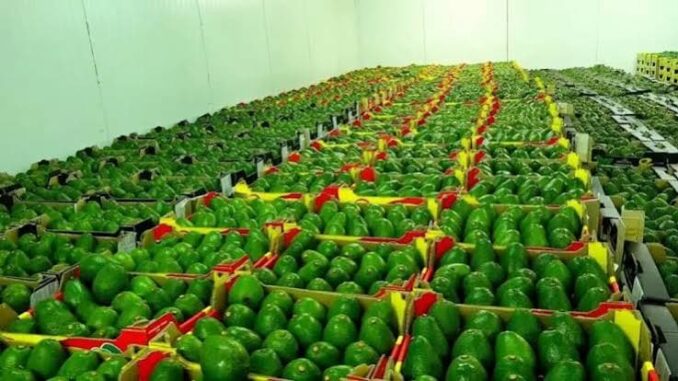
Kenyan agricultural exports form a cornerstone of the country’s economy, generating significant foreign exchange, supporting millions of smallholder farmers, and ranking among Africa’s strongest performers in tea, cut flowers, and emerging high-value crops like avocados.
Top Agricultural Export Products
Kenya’s export basket is dominated by a few high-value categories:
- Tea (including flavored varieties): The clear leader. Kenya ranks as the world’s largest or near-largest tea exporter by volume/value in recent data. Tea (often grouped with coffee and spices) generated around $1.3–1.7 billion in recent years and remains the top single product. Key destinations include Pakistan, Egypt, the UK, UAE, and Russia. Production and earnings fluctuate with weather, but it consistently leads farmgate and export value (worldstopexports.com).
- Cut flowers and live plants (floriculture): Typically the second major earner, valued at roughly $780–785 million. Kenya is one of the world’s top flower exporters (third globally after the Netherlands and Colombia in many rankings) and the largest supplier of cut flowers to the European Union. Roses dominate, with the Netherlands serving as the primary auction/hub (often 60%+ of volume), followed by the UK, Germany, France, and other European markets. Direct supermarket sales are growing.
Coffee
- High-quality Arabica from regions like the central highlands. Export values have been in the $280–310+ million range. Destinations include traditional markets in Europe and the US, with ongoing efforts to boost specialty and value-added sales.
- Fruits and nuts: Strong growth area. Avocados (mainly Hass) have boomed, with export values around $160–175 million in recent years and volumes expanding significantly (Kenya is Africa’s top avocado exporter). Access to China (opened around 2022) and steady EU/Middle East demand have driven expansion; production areas include Kiambu, Murang’a, Nakuru, and Kisii. Other contributors include mangoes, bananas (strong domestic value), and nuts such as macadamia. Fruit export values rose notably (e.g., ~27% in one recent year) on avocado volume gains.
- Historically important (French beans, snow peas, etc.), contributing hundreds of millions, but facing pressure. Values and volumes have declined in some periods due to stricter EU maximum residue level (MRL) rules and interceptions for pesticide residues.
- Other notable items: Animal/vegetable fats and oils, spices, and some livestock products (e.g., goat meat). Horticulture overall (flowers + fruits + vegetables) frequently ranks among the top foreign-exchange earners alongside tea.
In broader 2025 trade data, the “coffee, tea, spices” category led total Kenyan exports, followed by mineral fuels, then live trees/plants/cut flowers, with fruits/nuts and vegetables also ranking high.
Major Markets and Trade Patterns
- Europe (especially the Netherlands as a logistics hub, UK, Germany, France, Spain): Dominant for flowers, avocados, and many horticultural products due to proximity, air/sea links, and premium demand.
- Africa (Uganda and the East African Community more broadly): A large and growing share of total exports, often for processed or lower-value agricultural goods and regional trade.
- Middle East and Asia (UAE, Pakistan, growing China for avocados, others): Important for tea, fruits, and diversification.
- United States and other markets: Smaller but relevant for coffee, specialty products, and some apparel-linked agri trade.
Growth Trajectory and Key Statistics
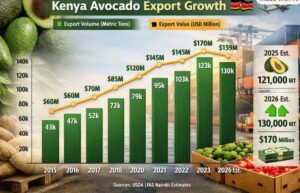
Mid-2010s baseline: Around 43,000–52,000 metric tons (MT) annually (e.g., ~43k MT in 2015, ~47k in 2016, ~52k in 2017).
Acceleration phase: ~72k MT (2018), dipping slightly then rising to ~79k (2020), ~95k (2021), ~103k (2022), and ~123k MT (2023).
Recent years: 2024 volumes reported in the 100k–130k MT range depending on the source (with fruit export values boosted significantly by avocados). 2025 exports were revised downward to approximately 121,000 MT (from earlier projections near 135k MT), valued at around $159 million.
Drivers of Growth
Global demand — Rising interest in avocados for healthy fats, plant-based diets, and food/cosmetics uses. Hass variety suits long-distance shipping.
Market access— China market opened ~2022(Kenya quickly became a notable supplier, ranking third at times); growth in Middle East (especiallyUAE);emerging opportunities in India, Iraq, and others. EU remains the core high-value destination.
Infrastructure and organization — More packhouses, exporters (hundreds registered), and cold-chain capacity, though still constrained. Reliable logistics partners have become essential to convert production gains into successful shipments. Fruit export values overall surged in years like 2024 partly on avocado volume gains.
Major Markets
Middle East (UAE ~19% and rising, Saudi Arabia, others).
Asia — China (growing, with duty-free or preferential access improvements noted in 2026 contexts), plus emerging volumes to India and others.
Seasonal peak typically March–August (Hass focus), with off-season restrictions favoring air freight for quality control. Companies such as Rapidlex Logistics support exporters targeting these markets by offering cost-effective sea freight from Kenya (including container shipping via Mombasa), air cargo from Nairobi for urgent or off-season loads, and tailored multimodal solutions that help maintain fruit quality on longer routes.
Challenges and Recent Setbacks
Logistics disruptions — Red Sea/Suez issues extended transit times to Europe (from ~20–25 days to 40–50 days), raising costs, risking quality, and reducing competitiveness. Morocco benefited from shorter Mediterranean routes and overtook Kenya as Africa’s top exporter by volume.
Quality and regulatory controls — Agriculture and Food Authority (AFA) measures against premature harvesting (including temporary sea-shipment restrictions) reduced eligible volumes to protect reputation and meet importer standards (maturity/dry matter requirements, pest controls).
Domestic competition — Rapid rise in avocado oil processors (from a handful to dozens) increased demand for fruit, pushing up farmgate prices and sometimes encouraging early harvests that lower oil yields and fresh-export quality.
Other pressures — Climate/rainfall variability affecting sizing and yields; high input/logistics costs; need for consistent GLOBALG.A.P./phytosanitary compliance; and competition from Mexico, Peru, Colombia, South Africa, and Morocco.
False codling moth and thrips issues have also appeared.
- Logistics and costs — Air freight is expensive for perishables; sea freight faces Red Sea/Suez disruptions that lengthen transit times and affect quality (particularly avocados). Port and cold-chain infrastructure remain constraints.
- Climate variability — Droughts, irregular rains, and weather extremes impact tea, coffee, and horticultural yields.
- Currency, input costs, and value addition — Shilling fluctuations, rising fertilizer/fuel costs, and limited local processing (most tea and coffee exported in bulk form) squeeze margins. Premature harvesting controls (e.g., for avocados) and quality enforcement add operational complexity.
- Competition and market access — Rising regional competitors and the need for diversification beyond traditional European buyers.
Opportunities and Outlook
Growth areas include avocado expansion into new markets (China and Middle East), specialty/value-added tea and coffee, sustainable and certified produce (organic, fair-trade, GLOBALG.A.P.), and better cold-chain/sea-freight shifts for horticulture to cut costs.
Government and industry efforts focus on compliance training, market diversification, and infrastructure. Smallholders remain central, with cooperatives and outgrower schemes linking them to exporters.
Overall, Kenyan agricultural exports demonstrate resilience and global competitiveness in niche high-value categories despite weather, regulatory, and logistics pressures.
Tea and flowers provide stable foundations, while fruits like avocados offer dynamic growth potential. Continued investment in quality, sustainability, and logistics will be key to expanding market share and farmer incomes.
Leave a Reply